A gradual slope between a lakefront home and the water is rarely a straight run. Neither is the slope down to an irrigation pump near a creek, or the drop along a trail cut into a hillside. Standard fixed staircases are built for one rise and one run; set on ground that changes shape underfoot, they settle unevenly or need a poured foundation that defeats the point of a portable solution.
That is the gap portable stairs for gradual slopes are meant to close. Hotwood's Anywhere Stairs is a modular aluminum stair system with steps that adjust to the terrain instead of forcing the terrain to match a fixed set of steps. Before ordering one, a property owner needs to measure the site itself.
Start With Total Rise and Available Run
Before comparing stair sections, measure the vertical height from the lower access point to the upper landing. That single number, the total rise, determines how much stairway you actually need to order.
Next, walk the route and measure the horizontal distance the stairway will cover, not just the straight-line distance between the two ends. A bank rarely holds one angle from top to bottom; it flattens, dips, or curves along the way, and a stairway has to follow that full path rather than an idealized straight line.
Note where the ground is uneven, where rocks or roots sit close to the surface, and exactly where the stairway needs to begin and end. Those details decide how the sections get arranged once you start planning the layout.
Adjustable Steps That Follow the Slope Instead of Fighting It
Fixed-step staircases assume a single, consistent angle. On a bank that changes slope along its length, that assumption falls apart fast: steps set for one part of the bank sit at the wrong angle on another.
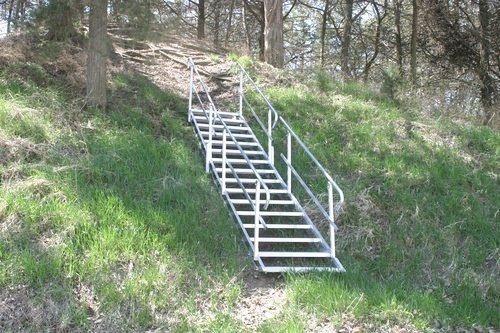
Anywhere Stairs addresses this with steps that adjust to a flat position regardless of the slope underneath them. Hotwood's describes the setup as positioning the stairs on the bank, adjusting each step's angle until it sits level, tightening the bolts on the framework, and staking the unit in place.
Because each step adjusts on its own, the same stairway can follow a bank that drops more sharply partway down or levels out near the water, without a custom-built frame for that one site.
Bolt 4-Foot and 8-Foot Sections Into the Length You Need
Anywhere Stairs comes in 4-foot and 8-foot sections that bolt together to build a longer, continuous stairway. Hotwood's own example connects two 8-foot sections into a 16-foot run, which gives a sense of how the math works for a longer bank.
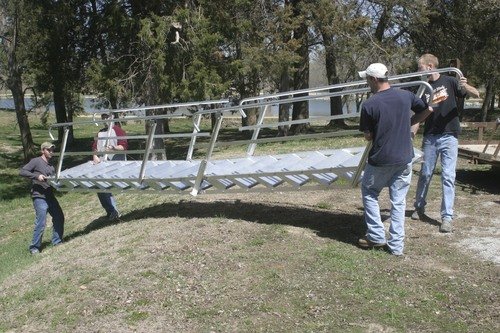
Before requesting a configuration, add up the horizontal run measured in the first step, and think in 4-foot increments. A bank with a 20-foot run might call for two 8-foot sections and one 4-foot section, for instance, though the exact arrangement depends on the site.
Match the 36-Inch Width and 35-Inch Handrails to Your Site
The stairway itself is 36 inches wide, with handrails listed at 35 inches tall. Before ordering, check the width against the approach on both ends: a path that narrows to less than a yard at the top or bottom will feel tighter once a 36-inch stairway sits inside it.
Installation follows the same steps described above: position the unit, adjust the steps to level, tighten the framework bolts, and stake it down. Hotwood's also offers a version with legs for sites where the standard base doesn't suit the rise, though the right configuration for a particular property is worth confirming directly.
For a raised entrance rather than a slope, such as a deck, a porch, or a jobsite trailer door, Hotwood's modular aluminum landings pair steps with a level landing at the door, a separate system from the terrain-following job Anywhere Stairs handles.
Where Hotwood's Customers Actually Install Slope Stairs
Lakefront property owners use Anywhere Stairs to connect a house or yard to the waterline across a gradual or uneven bank. When planning a new dock, understanding basic pontoon and dock terminology can help clarify the different parts of a waterfront setup. Once the dock and stairway are in place, pontoon accessories can help make time on the water more enjoyable.
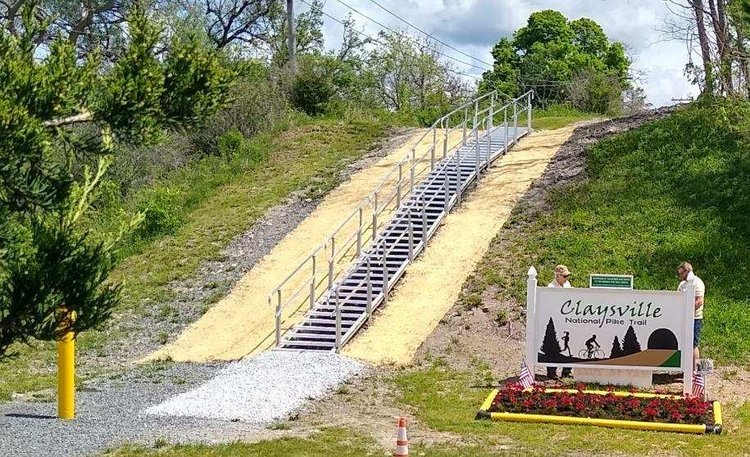
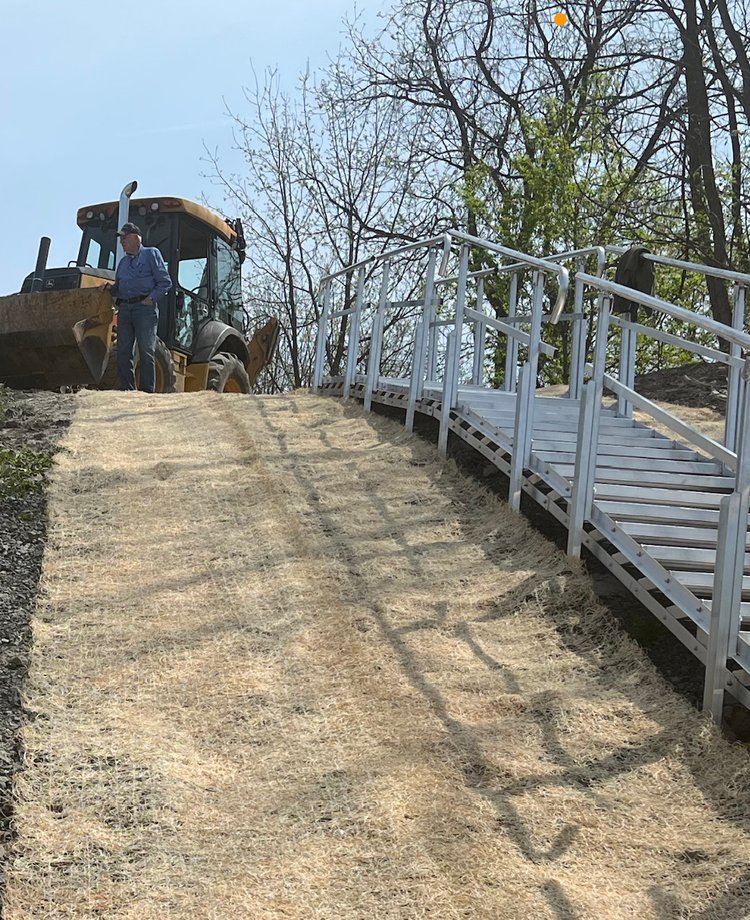
Parks departments and trail managers use the same adjustable design to provide a defined route across terrain that would otherwise need grading or a built staircase. Farmers use it to reach irrigation pumps positioned near creeks or ponds, where the bank down to the pump is often the least convenient part of the site.
Aluminum Stairs With Stainless Hardware, Built to Stay Outside
Anywhere Stairs is manufactured from 100% aluminum, with stainless steel hardware holding the sections together. Both materials suit a stair system that stays outside in all weather, since neither one depends on a coating to resist rust.
Hotwood's positions the system as low-maintenance, with the main upkeep being occasional checks on the bolts and adjustments to the step angles if the ground shifts underneath the stairway over time.
Is the Anywhere Stairs System Right for Your Property?
Before reaching out, it helps to have a few answers ready: the terrain you need to cross, the total rise and run you measured, and how much space is available where the stairway starts and ends. A Hotwood's representative can then work through whether a standard arrangement of 4-foot and 8-foot sections covers the site, or whether the version with legs fits your particular rise better.
Planning a stairway for a gradual bank or uneven property? Contact Hotwood's to discuss your measurements and explore the Anywhere Stairs configurations available for your site, or call (877) 407-8645.
Frequently Asked Questions
Does the version with legs replace the standard base, or is it only for certain rises?
The version with legs is built for sites where the standard base configuration doesn't match the rise, rather than as a universal upgrade. Since the right choice depends on the specific slope and landing points, it's worth confirming the configuration with a Hotwood's representative before ordering.
Will the aluminum and stainless hardware hold up through a full winter at a lake property?
Aluminum and stainless steel don't rust the way painted or plain steel does, which is part of why Hotwood's uses them on a system meant to stay outside year-round. That said, snow and ice still need to be cleared from the steps like any other outdoor stairway, and the bolts are worth checking after the ground freezes and thaws.
What if my site's measurements don't divide evenly into 4-foot and 8-foot sections?
Sections combine in 4-foot and 8-foot lengths to get close to the run you measured, and most sites don't need an unusual exact length to get a workable stairway. For a site where the numbers don't line up neatly, a Hotwood's representative can help work out the closest practical combination.